
Build an agency prospect pitch around evidence a buyer can inspect
Watch on YouTube ↗YouTube loads when you press play.
Your editable templates
Keep the question, source evidence and next action together. Download a template and adapt it for your team.
- Editable working documentMarkdown · Download ↓
The complete kit, blank tables and clearly labelled worked examples.
- Spreadsheet worksheetCSV · Download ↓
Blank response fields arranged by section and table row for your spreadsheet.
- Printable worksheetPDF · Download ↓
A designed worksheet for your meeting, review or handover.
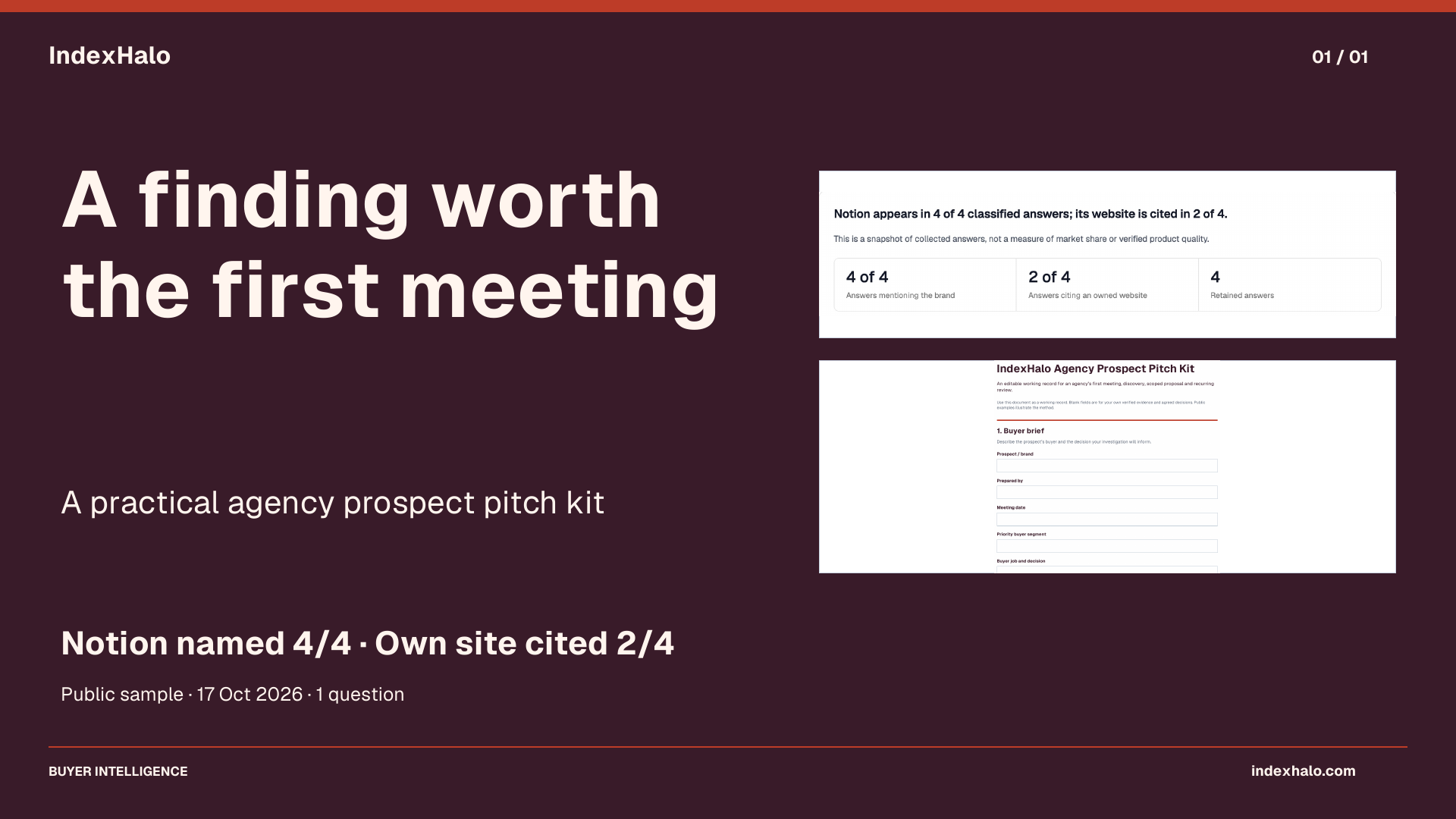
A useful agency pitch makes the first conversation easier. It gives the prospect a buyer question, a finding they can inspect and a concrete piece of work to discuss. The downloadable IndexHalo prospect pitch kit turns those ingredients into an opening page, a discovery sheet and a scoped proposal. Use it to connect your research to the prospect’s priorities and build a clear starting point for an ongoing service.
Choose the buyer decision before the pitch
Start with the audience the prospect wants to reach and the decision that audience is making. A category question, a required integration or a plan-selection question can each produce a useful investigation. Record why that question matters commercially: perhaps buyers need to understand a workflow, compare a cost or recognise the product’s suitability for a particular team.
Use discovery to refine that reasoning. The prospect knows its customers, sales conversations and current priorities. Your initial research should give that conversation something concrete to work with. The kit’s buyer brief records the audience, job, decision, requirements and reason for investigation.
Keep the research scope with the result
Record the exact question, brand, country, language, collection settings and date. Add the usable answer count and a link to the saved report. These fields make the evidence easy to reopen and define the scope for a later comparable check.
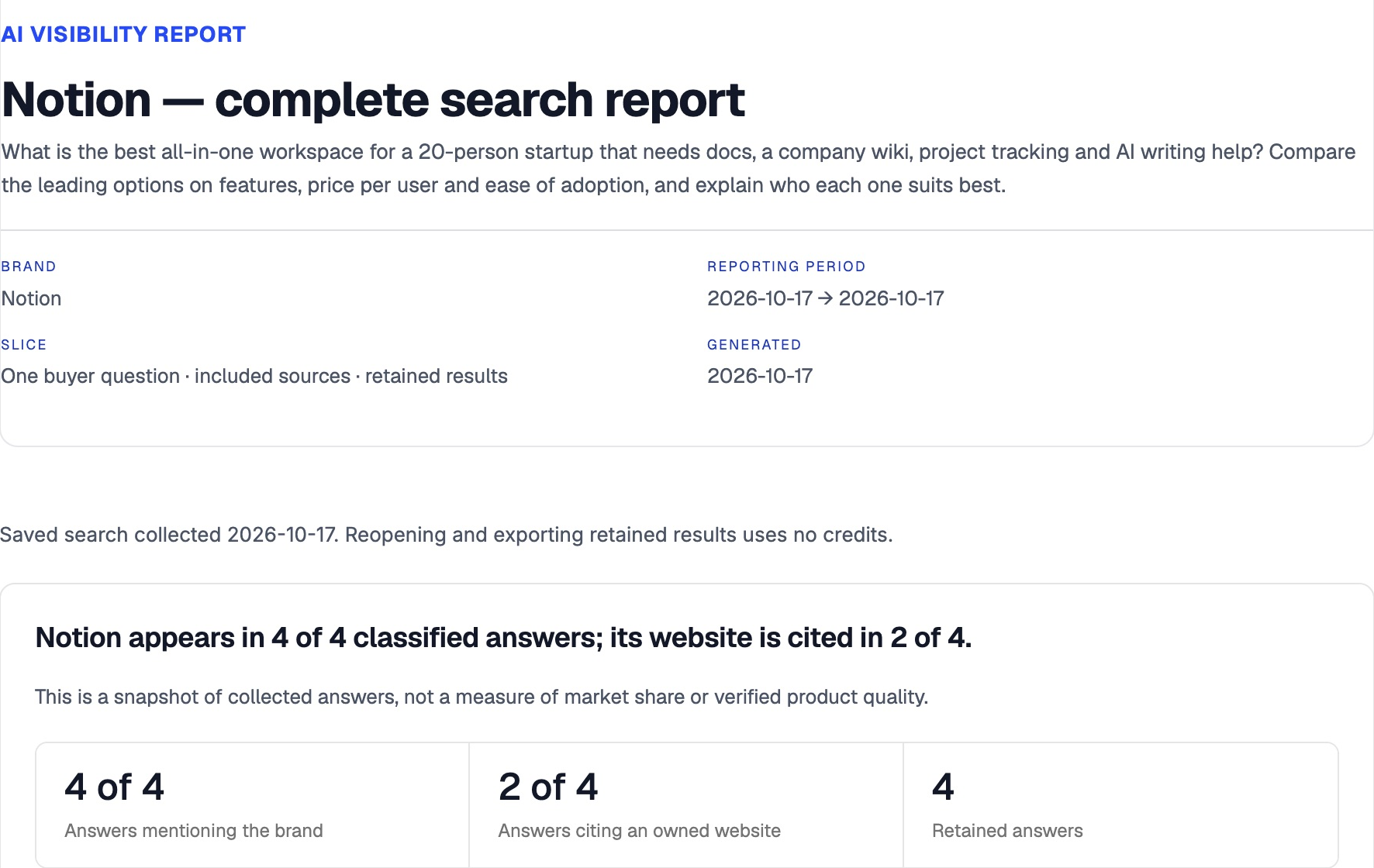
The exact retained question is: “What is the best all-in-one workspace for a 20-person startup that needs docs, a company wiki, project tracking and AI writing help? Compare the leading options on features, price per user and ease of adoption, and explain who each one suits best.” In the public Notion example used here, this question produced four usable answers on 17 October 2026. All four name Notion, while two cite its own website. The two counts describe brand presence and owned-source presence within this answer set. They provide a public example of the pitch method.
Turn the headline into an evidence packet
Open the retained answers and identify the passages relevant to the buyer’s requirements. Keep each selected claim beside the answer link, cited page and collection date. For the two answers without a Notion-site citation, inspect the sources used and the information they provide before choosing a recommendation.
The packet should let a prospect follow the same trail you followed. A large, readable screenshot supports the opening page; the retained answer and source links support detailed review. Use the shortest accurate finding that preserves the question, date and denominator.
Check the facts behind the proposed work
Select a few claims that could influence the buyer’s decision. A price needs a plan, currency, billing interval and unit. A feature claim needs its availability and relevant conditions. An integration claim needs the exact workflow being promised. Notifications, source-data sync and AI search across an app can be distinct capabilities.
The claim-check table gives you space for the answer’s wording, the official source, the verification date and your assessment. Use it to separate confirmed information from missing context or a question that needs the prospect’s product specialist. The result is a focused research deliverable the prospect can evaluate.
Build a one-page opening
Use four blocks: the buyer decision, one finding, the business question it raises and the proposed next step. Put the actual report crop alongside the finding and retain its date. Give the reader an obvious route to the evidence.
A worked opening in the template reads: ‘We reviewed one buyer question in a saved answer set. Notion was named in four of four usable answers, while its own website was cited in two. We propose reviewing the relevant claims and cited pages against official product information, then agreeing which explanation deserves attention.’ Replace every example field with your own verified research before using the kit.
Ask discovery questions that affect the scope
Ask which buyer segment matters most, which questions appear in sales conversations, what has recently changed in the product and which pages already explain it. Find out who can confirm pricing or integration details and who approves a public update.
These answers help you choose the right work and owner. They may lead to a product-information review, a content brief, a technical clarification or a change to the questions being measured. Record the decision in the kit rather than leaving it buried in meeting notes.
Write a proposal someone can approve
List the selected questions, the answer and source review, the claim-check table and the proposed page brief. Specify the owner, delivery date, required inputs and review meeting. Describe what the prospect receives in terms that can be checked.
Estimate research, verification, writing, implementation and review separately. Add your agency’s fee and terms through its normal commercial process. The kit leaves effort and price editable so the estimate reflects the agreed work and the people responsible for it.
Agree the completion checks
A claim review is complete when each selected claim has a source and a clear assessment. A page brief is complete when it names the target page, buyer requirement, proposed change and acceptance checks. If implementation is included, retain the live URL and publication date.
A later observation belongs in its own record with the matching scope and collection date. Keeping delivery evidence and measurement evidence together gives the prospect a useful history of the engagement and a clear basis for the next decision.
Give the recurring service a purpose
Product information, buyer questions and cited sources can change. An ongoing review can maintain a stable set of important questions, add selected investigations and close each period with a decision about what to maintain, investigate or change next.
Calculate the search allowance from that scope. For example, six questions across two market settings and four collection rounds use 48 complete searches; any exploratory work belongs on a separate line. This is an illustrative workload to adapt. IndexHalo includes its full feature set on every subscription. One credit is one complete search, and monthly credits reset without rollover.
Use the editable kit for the next meeting
Download the kit, complete the buyer brief and add one finding from a free IndexHalo report. Bring the evidence into the conversation, use discovery to refine the recommendation, and leave the prospect with a scope they can share internally.
The same working record can carry into delivery: the original question, source review, proposed task, owner and next review are already in one place. Choose a monthly search allowance for the clients and questions you intend to keep reviewing.
Public Notion example: one question, four usable answers collected 17 October 2026. Illustrates a proposed agency workflow.
Start your free report, then plan a monthly search routine that fits your team. Every tier includes the full feature set; monthly credits reset without rollover.
