
Compare UK and US buyer answers before choosing local content work
Watch on YouTube ↗YouTube loads when you press play.
Your editable templates
Keep the question, source evidence and next action together. Download a template and adapt it for your team.
- Editable working documentMarkdown · Download ↓
The complete kit, blank tables and clearly labelled worked examples.
- Spreadsheet worksheetCSV · Download ↓
Blank response fields arranged by section and table row for your spreadsheet.
- Printable worksheetPDF · Download ↓
A designed worksheet for your meeting, review or handover.
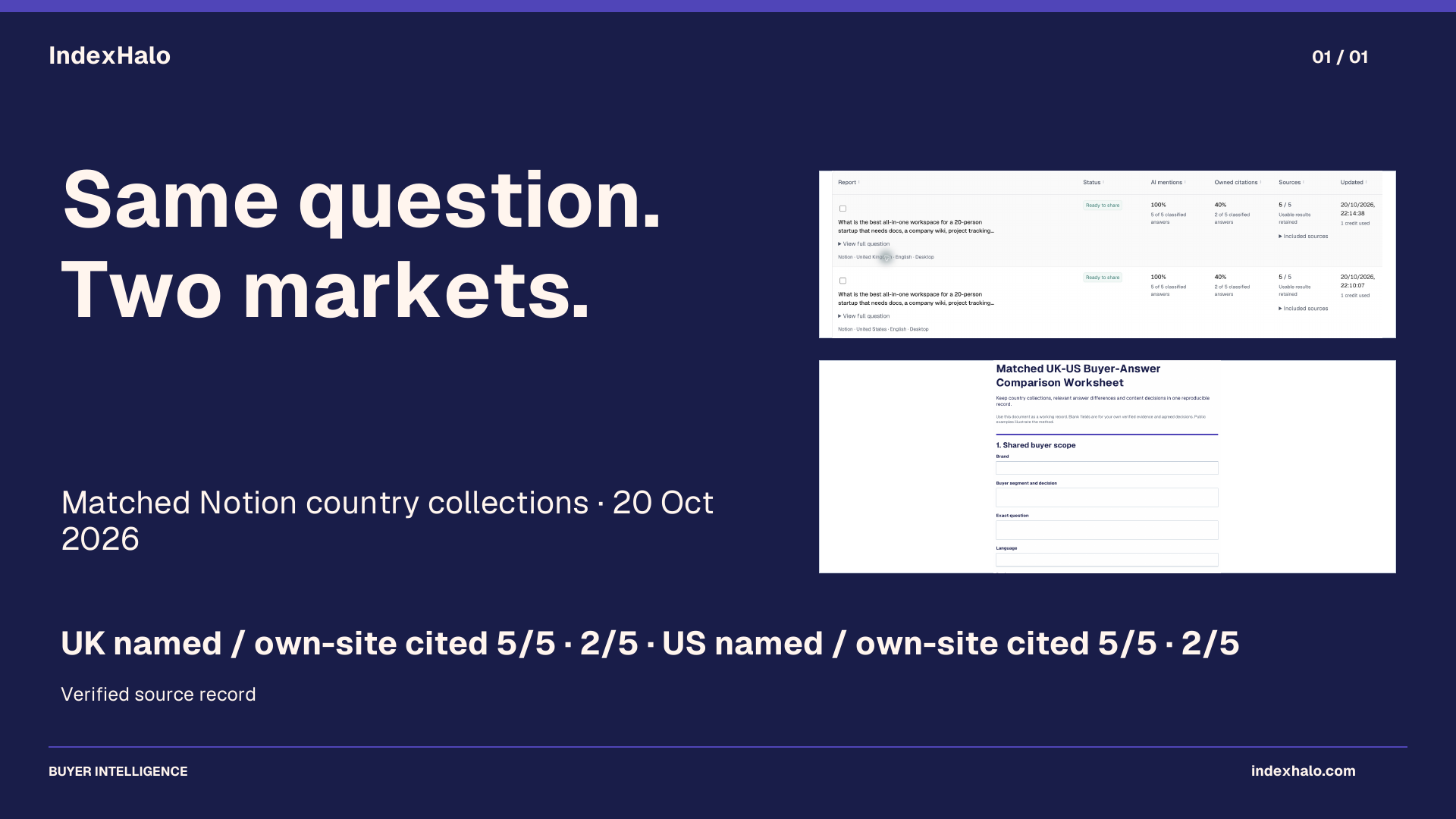
The matched Notion runs have identical headline metrics: 5 of 5 answers name the brand and 2 of 5 cite its website in each country set. The useful differences appear in the recommendations, pricing context and cited-page mix. This guide follows that real comparison into a focused decision about shared content, further investigation and local explanation.
Use one shared buyer question
The exact question is: “What is the best all-in-one workspace for a 20-person startup that needs docs, a company wiki, project tracking and AI writing help? Compare the leading options on features, price per user and ease of adoption, and explain who each one suits best.” The wording is identical across the UK and US collections.
A common question gives both sets the same buyer requirements. Keep it in the worksheet so anyone reading the result can understand the decision being investigated and repeat the scope later.
Preserve the country and collection context
Keep the country, language, Desktop Google setting, included sources and collection time with each set. Preserve each source’s method label: AI search or interface captures and model API responses remain identifiable. Country context is supplied through source-specific settings; the API sources also receive a written audience instruction. This makes the comparison explicit about what was collected.
Both collections were completed on 20 October 2026. Source timestamps span 20:09:14–20:10:07 UTC for the US set and 20:13:47–20:14:38 UTC for the UK set. The recorded scope is whole-country United States or United Kingdom, English, the Desktop Google setting and five included sources. These are observations from one matched pair; the pair alone does not isolate country as the cause of a difference.
Check the usable answer coverage
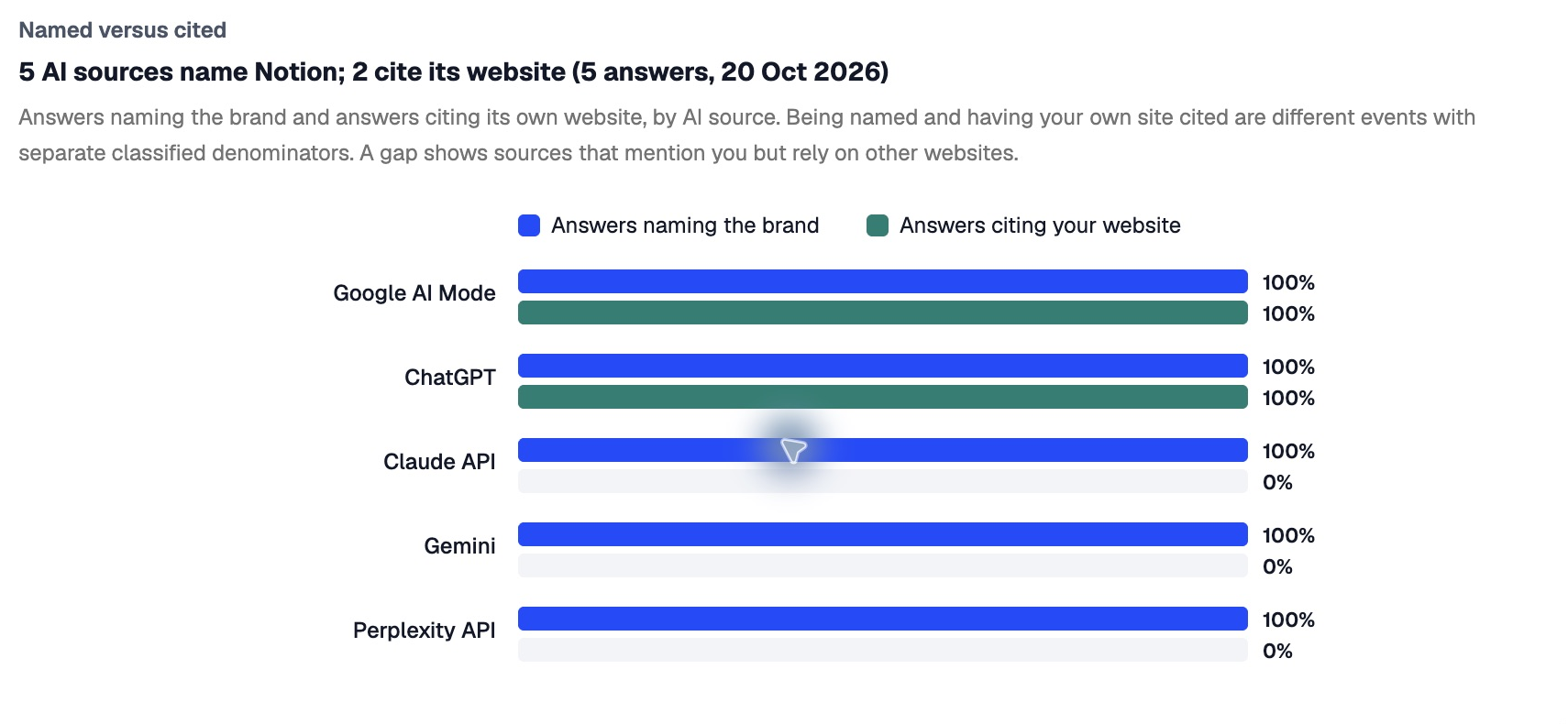
Both sets contain five usable answers: Google AI Mode, ChatGPT, Claude API, Gemini and Perplexity API. Google AI Mode and ChatGPT cite Notion’s configured owned website in both country sets. Claude API, Gemini and Perplexity API do not cite it in these retained answers.
Read overall counts and source-by-source results together. A missing observation should remain missing rather than becoming a zero. For a close comparison, start with sources that have usable answers on both sides and keep any additional observations labelled separately.
Read the recommendation pattern
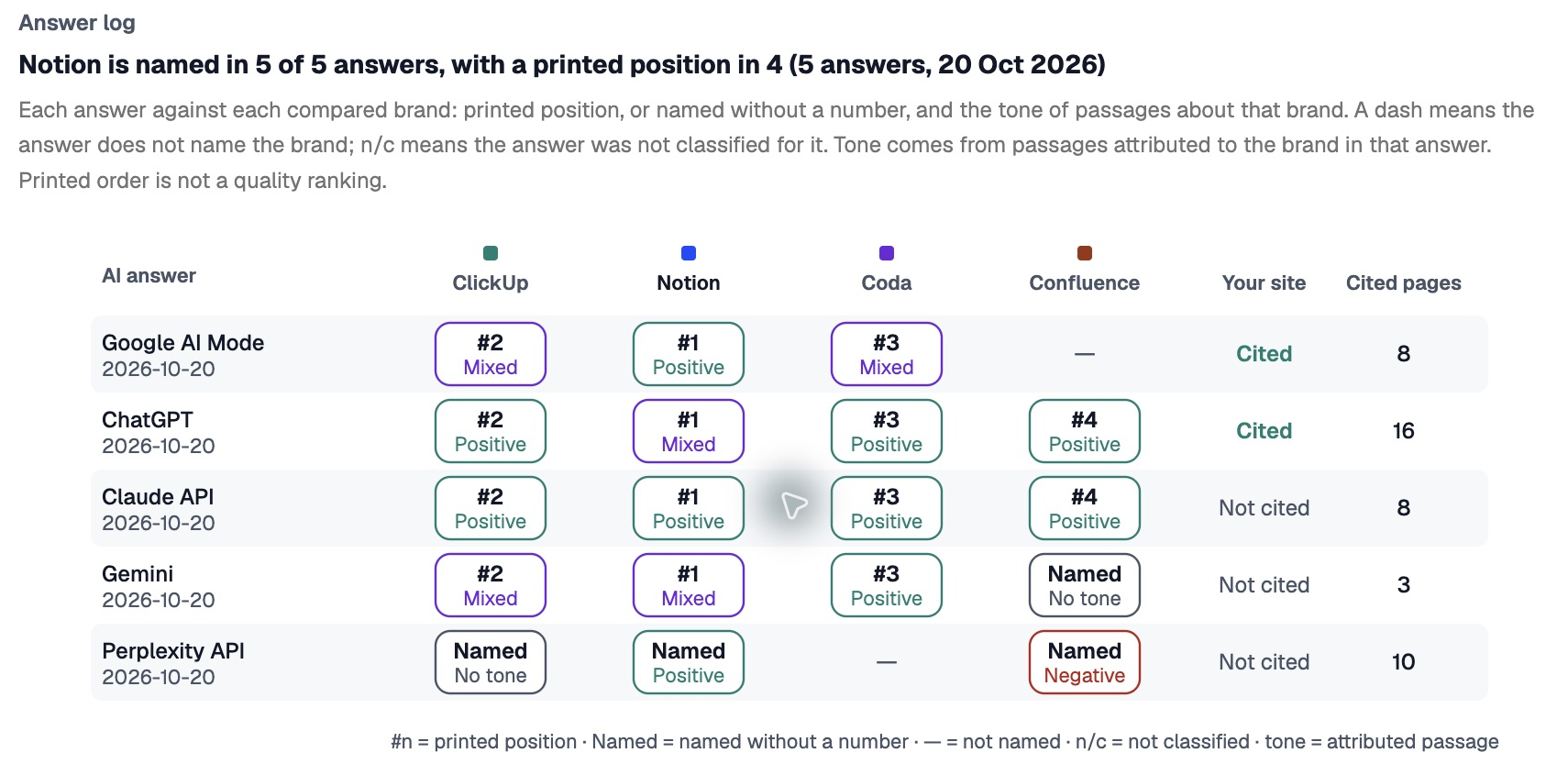
Notion and ClickUp are named in 5 of 5 answers in both country sets. Coda appears in 2 of 5 UK answers and 4 of 5 US answers. Confluence appears in 5 of 5 UK answers and 4 of 5 US answers. These counts describe observed brand mentions within the two sets, giving the team a specific comparison context to inspect.
Open the answer passages behind the counts. Note which buyer requirements support the recommendation and whether the products are positioned for different kinds of team. A useful finding explains the observed pattern within these samples and identifies the detail worth reviewing.
Compare brand mentions and owned citations
Notion has the same headline result on both sides: 5 of 5 usable answers name the brand and 2 of 5 cite its owned website. The owned-citation rate is therefore 40% in each set. These equal measures make the next level of inspection especially useful: the answer detail can vary even when the headline totals match.
Brand mentions and owned-site citations answer different questions. Preserve both counts with their denominators, then inspect the cited URLs and relevant wording. This helps the team decide whether to investigate product information, source support or an existing official explanation.
Inspect the buyer-facing detail
The two Perplexity API answers both describe Notion Plus at about US$10 and Business at about US$20 per user per month with annual billing. The UK answer explicitly adds that VAT, exchange rates and billing frequency may affect the final GBP cost. This is observed context in the answer, not a verified local checkout quote. A useful next check is the actual purchasing currency and terms that apply to the buyer.
If the difference concerns pricing, compare the plan, currency, billing interval and unit. If it concerns a feature or integration, verify the exact workflow and conditions. The official source and its check date belong beside the retained passage.
Read the source pattern
The UK report contains 40 distinct cited pages, including 13 pricing pages and 11 comparison or alternatives pages. The US report contains 41 distinct cited pages, including 12 pricing pages and nine comparison or alternatives pages. The categories are the report’s derived page types. They describe this collection pair and provide a concrete set of sources to inspect.
A source difference becomes useful when the team inspects the pages and the information they provide. Record shared pages as well as pages seen on only one side. The purpose is to understand the support behind the answer and identify any relevant official explanation.
Choose between shared content, investigation and localisation
Keep a shared explanation when the evidence indicates that it serves both audiences. Investigate when a meaningful detail is unclear or needs a product owner. Prepare a local update when verified information or buyer requirements justify it.
A country label by itself is not the content brief. Name the exact information to clarify, the intended buyer and the relevant market. Explain what can be reused from existing content and which source supports the proposed local detail.
Make the local brief reviewable
Specify the market, buyer question, target page, proposed clarification and fact owner. Add the retained answer and official source, then define a completion check. This gives a writer a focused task and a reviewer a clear standard.
Keep completed work and its publication date in a separate part of the record from the original observation. The next review can then follow the evidence, the decision and the delivered change without confusing them.
Build a repeatable comparison routine
Choose a stable core of commercially important questions and repeat the same country pairs. Keep new exploratory questions in their own group. Record changes in the answers alongside changes in usable source coverage, and inspect which differences persist over several observations.
One question measured once in a UK setting and once in a US setting uses two complete searches. The returned answers belong to those searches. Multiply the paired questions by the collection rounds you need, then allow room for targeted investigations. One IndexHalo credit is one complete search; monthly credits reset without rollover.
End each review with a decision
Record what the team will keep, investigate or change, why the evidence supports that decision, who owns it and when it will be reviewed again. The editable worksheet keeps the shared question, country settings, answer passages and source links together for the people making that decision.
Start with a free IndexHalo report for a buyer question that matters in both markets. Then choose the monthly search allowance for the country pairs and questions you plan to revisit. Every subscription includes the full feature set.
Public Notion example: one matched buyer question, UK and US country settings, five usable answers per country collected 20 October 2026. The observed pair supports source and content investigation; country is not isolated as the cause of differences.
Start your free report, then plan a monthly search routine that fits your team. Every tier includes the full feature set; monthly credits reset without rollover.

