
Audit the product facts buyers see in AI answers
Watch on YouTube ↗YouTube loads when you press play.
Your editable templates
Keep the question, source evidence and next action together. Download a template and adapt it for your team.
- Editable working documentMarkdown · Download ↓
The complete kit, blank tables and clearly labelled worked examples.
- Spreadsheet worksheetCSV · Download ↓
Blank response fields arranged by section and table row for your spreadsheet.
- Printable worksheetPDF · Download ↓
A designed worksheet for your meeting, review or handover.
A buyer may use an AI answer’s price, feature list or integration description to decide whether your product belongs on a shortlist. A product-information audit checks whether that answer gives the buyer the context they need. This walkthrough uses retained Notion answers in IndexHalo, a current official-source review and a claim-check worksheet that a product or content team can maintain.
Keep the buyer requirement beside the claim
The retained question asks for the best all-in-one workspace for a 20-person startup needing documents, a company wiki, project tracking and AI writing help. It asks for a comparison of features, price per user and ease of adoption. Those requirements define the audit: a low entry price is only useful when the package being described fits the work the buyer wants to do.
Keep the exact question with the selected claims. Then give each claim its own row, answer reference, plan or workflow, official source, assessment and next action. A review becomes much easier when a price and a feature entitlement are not bundled into one vague score.
Record the answer date and official-source date
The retained answers were collected on 17 October 2026. The official sources for this review were checked on 20 October. The question here is what a buyer needs to know when using the information now.
Preserve the original wording and date, then add the current source and check date. This lets your team recognise a product change without rewriting the historical observation. It also makes a later review easy to compare with the work already completed.
Read price as a complete statement
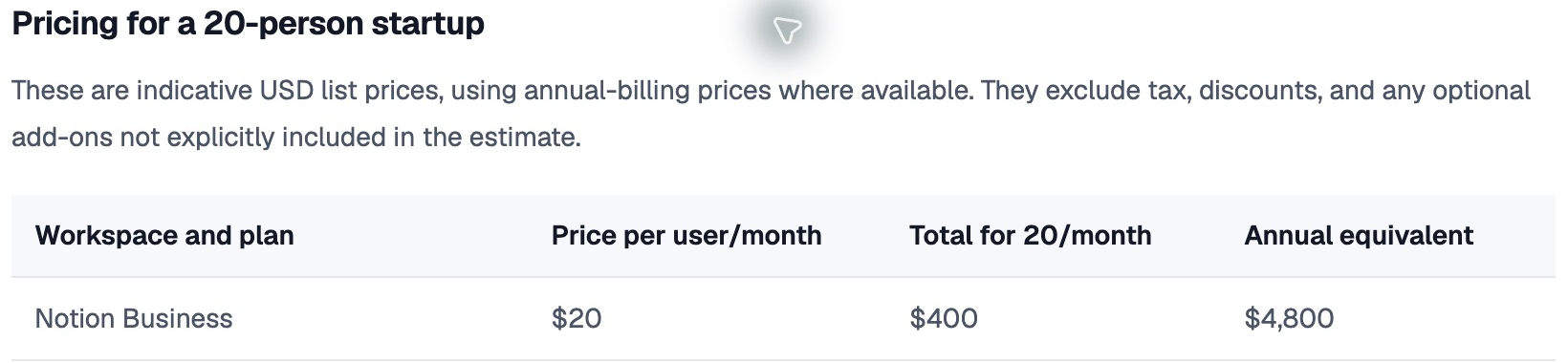
The retained ChatGPT answer lists Notion Business at US$20 per user per month with annual billing. It calculates US$400 as the monthly equivalent for 20 users and US$4,800 for the year. The arithmetic matches the stated rate and seat count. Whether that estimate is useful now also depends on the current plan, rate and billing conditions.
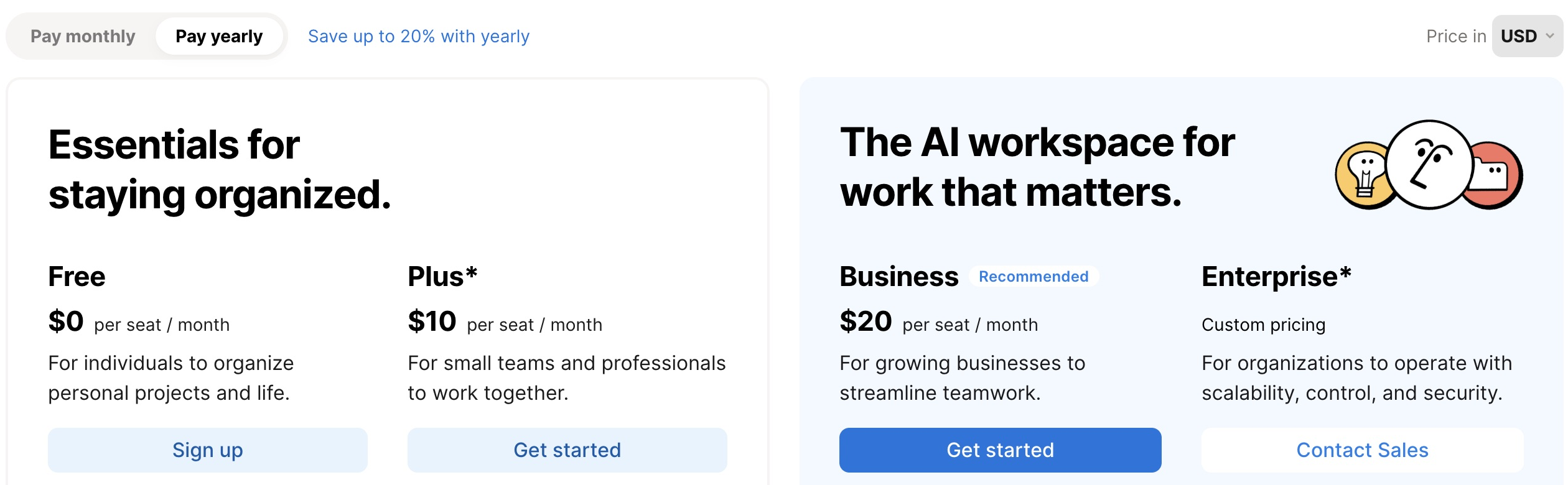
The official USD pricing view checked on 20 October confirms Plus at US$10 per seat per month with yearly billing or US$12 with monthly billing, and Business at US$20 or US$24 respectively. The retained Business annual rate matches the current annual view. For 20 seats, monthly-billed Business is a US$480 base monthly cost. Record the plan, currency, selected billing interval and unit. Keep a monthly equivalent under annual billing distinct from a month-to-month subscription price. Taxes, discounts and optional extras need their own treatment in a buyer’s estimate.
Confirm useful plan distinctions
The retained ChatGPT answer distinguishes Plus trial AI from Business-plan AI access. Current Notion plan documentation supports that distinction: Free and Plus provide limited trial usage, while Business and Enterprise include Notion AI access.
That is a useful confirmed finding. An accuracy audit should preserve clear information as well as identify questions to resolve. Record the official source and the relevant scope so a teammate can verify the distinction without repeating the whole investigation.
Add current context to broad usage wording
The retained Gemini answer describes ‘unlimited Notion AI access’. For a buyer evaluating the product now, that wording needs the applicable usage conditions. Notion’s current documentation describes AI allowances and a dated transition to a new credit system.
The official guide says the new system starts on 19 October for new Business and Enterprise workspaces and on 2 November for existing workspaces. Workspace status and effective date therefore belong in the check. The current review can ask for a more precise usage explanation without treating the later rule as proof that the 17 October answer was false at collection.
Check the fresh price range against the official plan
A fresh US Gemini answer collected on 20 October gives an approximate US$10–US$15 per-user monthly range, labelled Plus/Business tier plus an AI add-on. That range does not match the official Business base rate checked the same day: US$20 with yearly billing or US$24 with monthly billing, per seat per month.
The useful task is to supply the exact plan comparison: base price, billing interval, included AI access and applicable usage conditions. Preserve the original answer passage, link the official pricing view and assign the clarification to the person who owns the product information. This gives the team a current, specific pricing explanation to review.
Turn qualitative claims into practical evaluation
Ease of adoption appears in the retained answers as a qualitative assessment. A team can investigate it through a small set of real tasks: build an onboarding wiki, create a project, find a previous decision and try the required AI workflow.
Record the task, who attempted it and what they observed. This gives the buyer a relevant evaluation and keeps a qualitative description distinct from a measured onboarding result. The worksheet includes space for these follow-up checks.
Check the integration workflow, not only the app name
The retained Notion passages reviewed here do not make a specific Slack or GitHub promise that we can assess. Those integrations are included as follow-up checks for a buyer who needs connected workflows.
Notion’s official Slack documentation describes sending messages into databases and receiving activity notifications. Enterprise Search covers searching connected apps and is available on Business and Enterprise. Its synced-database guide describes one-way data flow from supported tools into Notion, also on Business and Enterprise. A useful explanation keeps those different workflows, plans and setup requirements separate.
Use assessments that lead to an action
Use confirmed when the matching source supports the statement. Use needs context when an omitted plan, billing basis or condition matters to the buyer. Use needs clarification when the product owner must resolve a detail. Use contradicted only for a direct conflict within matching scope and dates.
Write one sentence explaining the assessment. Then choose the next action: retain the accurate explanation, add a condition, verify a product detail or prepare a clearer page brief. The evidence should make the next step easy for a teammate to understand.
Create a brief the product team can verify
A useful output may be a plan-comparison update, a worked team-cost example, an integration explanation or a dated note about changed packaging. Attach the answer passage and official source, name the buyer question, and specify the target page and fact owner.
Agree the completion check before implementation. If the team publishes a change, record its live URL and publication date. A later answer collection belongs in a separate row with its own date and matching settings, keeping the delivered work and the observed answer history clear.
Make fact review part of the monthly routine
Revisit important questions when pricing changes, plans are reorganised, integrations launch or product requirements shift. Keep a stable claim table and update the official-source check date so the next review starts from a usable record.
Start with a free IndexHalo report and the claim-check worksheet. Choose a monthly search allowance for the questions your team needs to revisit. Every subscription includes the full IndexHalo feature set, allowing the audit and reporting routine to follow your workload.
Public Notion examples: retained answers from 17 October and a fresh US Gemini answer from 20 October 2026, reviewed against official sources checked 20 October. Integration checks are additional buyer follow-up checks.
Start your free report, then plan a monthly search routine that fits your team. Every tier includes the full feature set; monthly credits reset without rollover.

