Read an AI visibility report from finding to action
Watch on YouTube ↗YouTube loads when you press play.
Follow the finding back to its evidence.
Move through the saved example one decision at a time. The interface was captured on 20 October 2026; the underlying observation dates remain part of the evidence.
Start with the question and collection date.
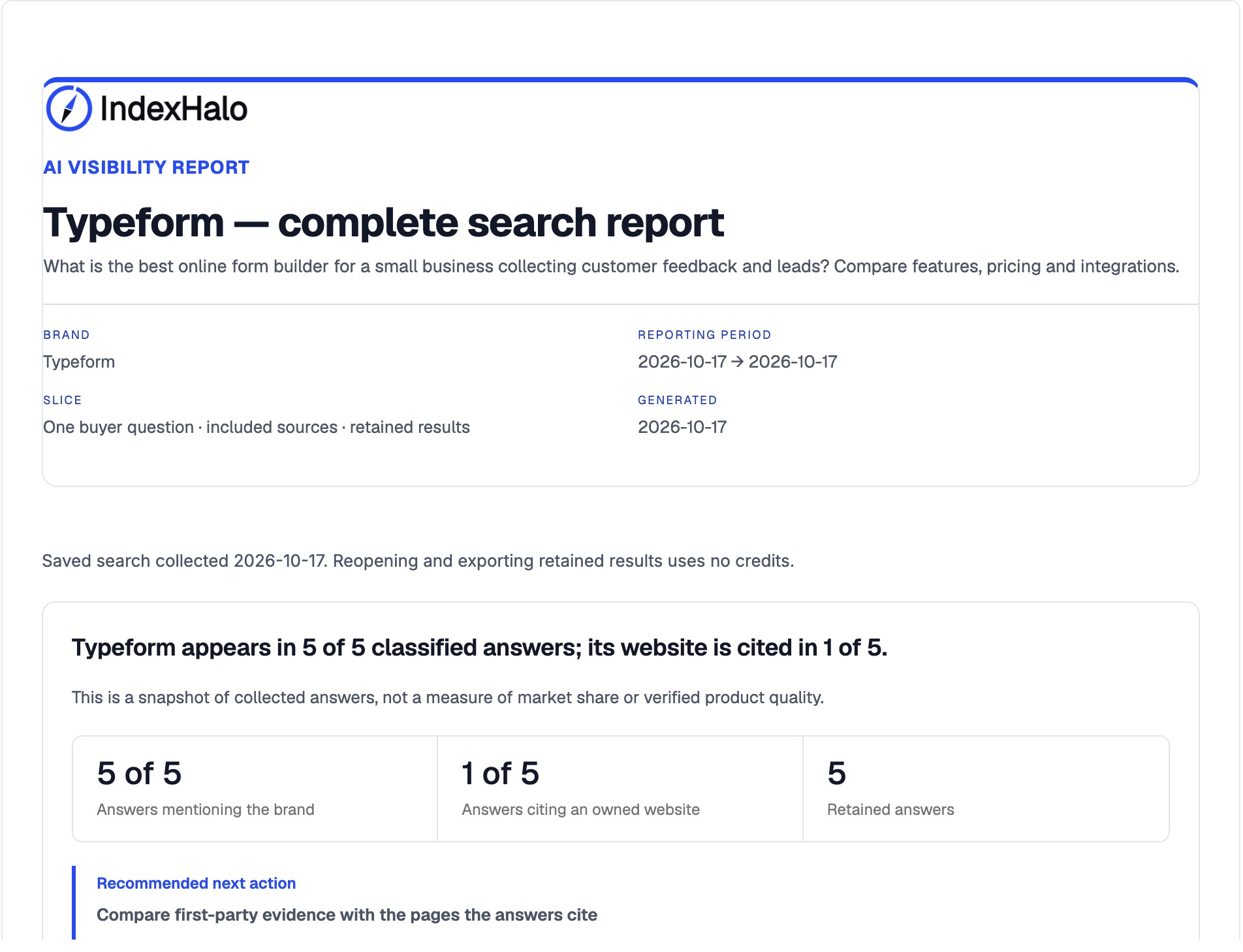
This saved report covers one form-builder buyer question and the answers collected on 17 October 2026. Its five retained answers are the denominator for the headline counts.
Your next check Keep the question, collection date, selected sources, market and language with your conclusion.
Read both counts and their denominator.
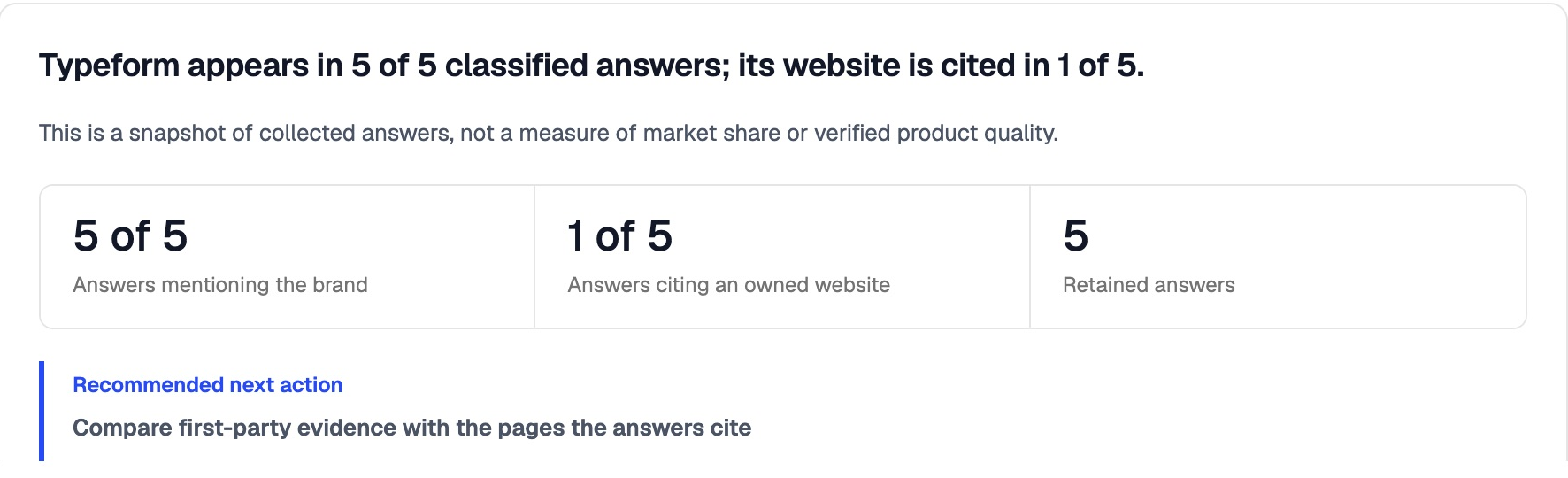
The report separates answers naming the brand from answers citing its own website: five of five mentions, one of five first-party citations. A mention establishes that the brand appears; a citation identifies a returned source.
Your next check Use “in these five retained answers” when explaining the finding.
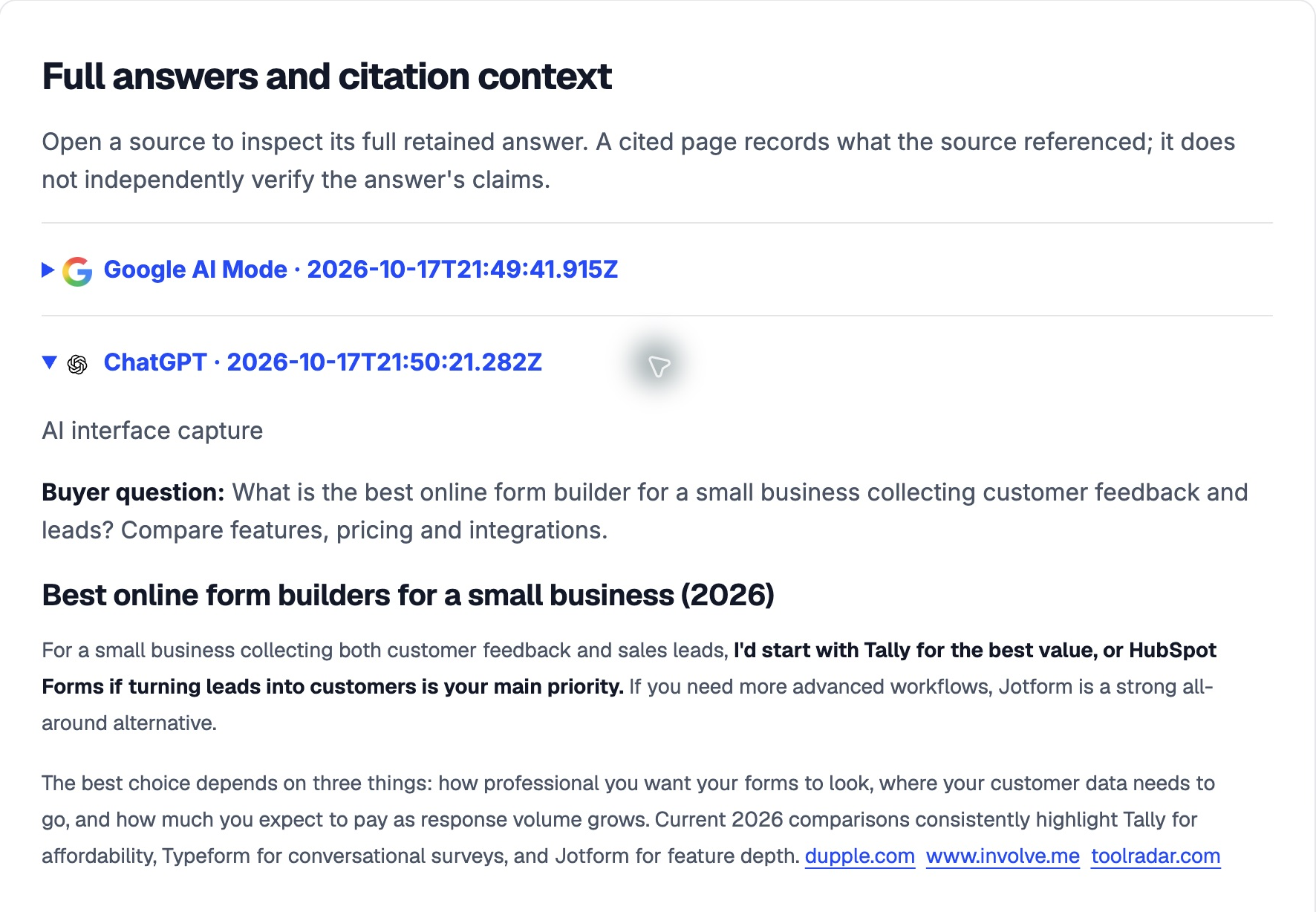
Inspect what the answer actually says.
The report keeps the original buyer question, collection method, answer timestamp and full answer together. The linked citations let a reviewer inspect the supporting pages. A cited page is a source recorded by the answer, not independent verification of every claim.
Your next check Follow the relevant source and verify its specific support before proposing a page change.
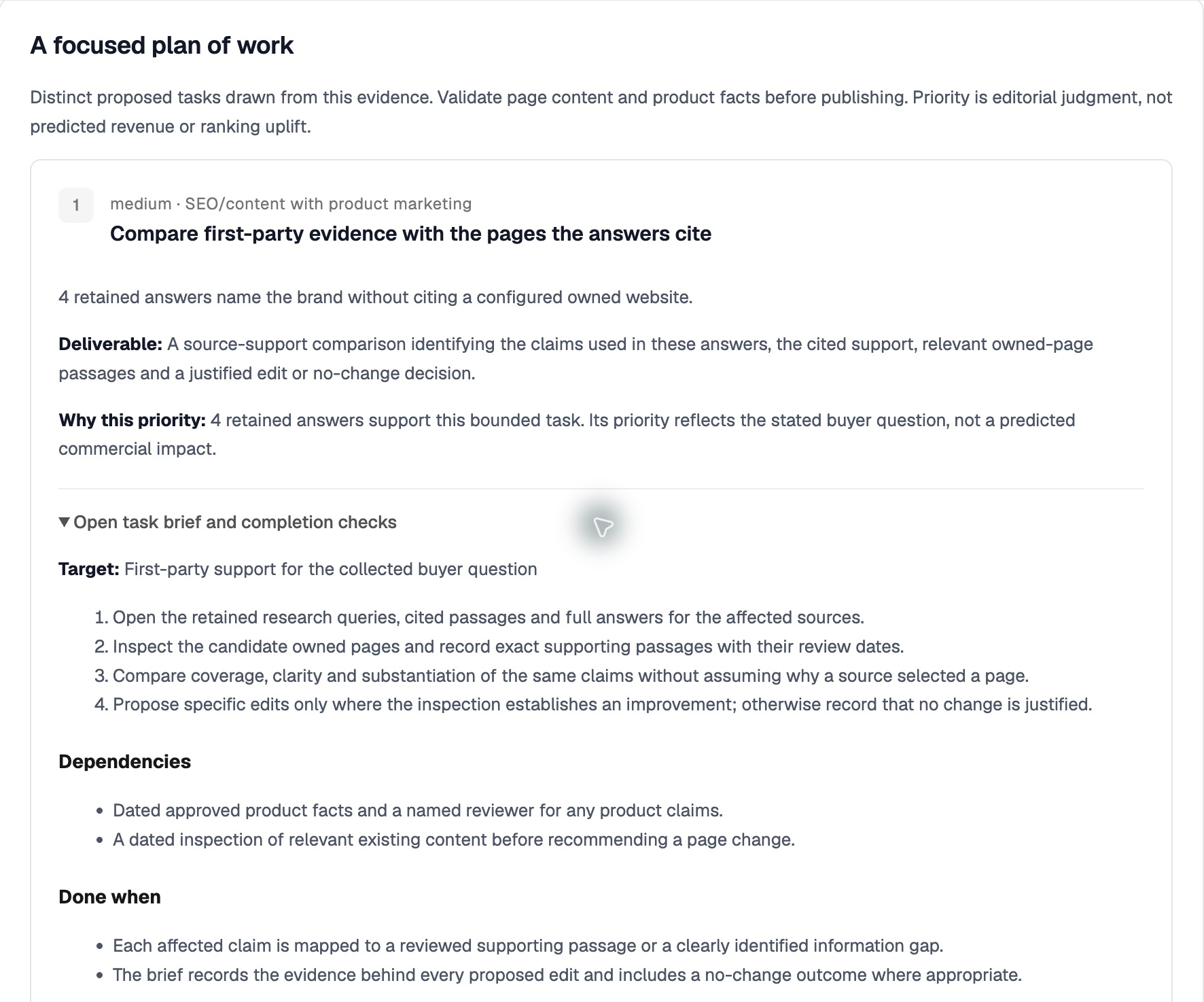
End with a task someone can review.
The report proposes comparing first-party evidence with the pages cited in the answers. Its brief identifies the target, research steps, supporting facts, owner and completion checks. It explicitly permits a justified no-change decision.
Your next check Keep proposed work, an approved published edit and a later comparable observation as separate recorded events.
An AI visibility report should help its reader make a decision. The most useful reading order moves from scope to finding, from finding to evidence and from evidence to a practical next step. This annotated walkthrough uses the current IndexHalo report reader and a saved public Typeform example to show what each section contributes.
1. Establish the scope before interpreting the finding
The report is titled “Typeform — complete search report”. It concerns one buyer question about the best online form builder for a small business collecting customer feedback and leads, with features, pricing and integrations to compare. The reporting period is 17 October 2026.
The report contains five retained answers from that complete search. The cover keeps the original question and date close to the headline, so a reader can understand what the evidence describes before deciding how it should influence the work.
2. Read the headline counts together
The summary states that Typeform appears in five of five classified answers and its owned website is cited in one of five. Brand mentions and first-party citations answer different questions. Together they show that the brand is present in this answer set, while other sites support most of the answers.
Use the supporting passages to inspect the finding. A useful review follows the exact wording and the source context rather than stopping at the percentage. The report's main recommendation is to compare first-party evidence with the pages the answers cite.
3. Understand the competitive comparison
The positioning section compares seven brands. Typeform, HubSpot and Jotform each appear in all five retained answers. Google Forms appears in four, Fillout and Tally in three each, and Zoho Forms in two. These counts describe which alternatives share this observed buyer conversation.
The share-of-voice chart uses 27 brand-answer mentions as its denominator. Each answer counts once for each brand it names. Typeform's five mentions therefore represent 18.5% of observed mentions in the seven-brand comparison set, tied with HubSpot and Jotform. This is a useful comparison within the saved sample.
The source matrix lets the reader inspect the pattern by AI source. Each included source has one retained answer here. All five name Typeform; the ChatGPT answer is the one that cites Typeform's own website. Opening those answers reveals the underlying discussion and cited pages.
4. Read the brand description in the original wording
The portrayal section adds supporting passages about the brand. In this report, connected workflows and price and value each have a passage attributed to Typeform in one of the five answers. These are useful starting points for understanding how the product is being described.
Open the exact passage and compare any important product statement with the relevant product evidence. The practical question is whether the wording helps the buyer understand the product accurately and whether a content or fact review would improve that understanding.
5. Use the source landscape to select the investigation
The report retains 41 distinct cited pages. The page-type chart shows 16 listicles, eight comparison pages, six pricing pages, four homepages, three product or feature pages, three documentation or help pages and one other page.
The citation-gap chart then identifies third-party sites cited in answers without a first-party citation. involve.me appears in three such answers. This gives the reviewer a specific set of answers and pages to inspect before recommending a content change.
Keep the unit with each chart. A count of distinct pages, a count of answers and a share of brand-answer mentions describe different parts of the evidence. The report's exact-value views make those quantities available for closer inspection.
6. Read the action plan as a deliverable
The proposed task is to compare first-party evidence with the pages the answers cite. Its deliverable is a source-support comparison identifying the claims used in the answers, the cited support, relevant first-party passages and a justified edit or no-change decision. SEO/content with product marketing is the suggested owner.
A reviewer should be able to finish that task with a clear decision about the page. The work record should identify the exact claim, relevant evidence, review date and the destination page or section for any approved change. This makes the recommendation suitable for a team planning discussion.
7. Share the report for its next use
The current report reader includes audience and file-format controls, an evidence-appendix option and layout, section and branding settings. Choose the version that helps the recipient make the next decision. A concise review can lead with the finding and task; a detailed review can include the evidence needed to inspect the recommendation.
Reading and exporting the saved report uses no additional search credit. The same retained evidence can support the team discussion, the brief and the later review. Start a free report with a buyer question from your own market, then choose a monthly search allowance for a recurring routine.
Public brand example · one buyer question · collected 17 October 2026 · current interface captured 20 October 2026. All numerical findings in this walkthrough refer to the saved Typeform report, not a market-wide ranking.
Start your free report, then plan a monthly search routine that fits your team. Every tier includes the full feature set; monthly credits reset without rollover.

