
Choose the next SaaS page with answer evidence
Watch on YouTube ↗YouTube loads when you press play.
A useful SaaS content plan connects the next page decision to a buyer's actual requirements. IndexHalo helps a team examine that connection through a saved question, the answers collected for it and their supporting pages. This public Linear example shows how detailed buyer context can become a focused review and an actionable content brief.
Start with the buyer's working context
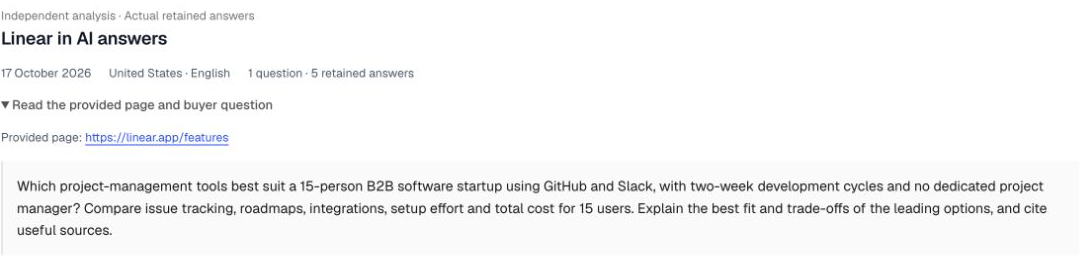
The exact retained question is: “Which project-management tools best suit a 15-person B2B software startup using GitHub and Slack, with two-week development cycles and no dedicated project manager? Compare issue tracking, roadmaps, integrations, setup effort and total cost for 15 users. Explain the best fit and trade-offs of the leading options, and cite useful sources.”
This question gives the writer a concrete audience and decision. The team size, existing tools and working pattern affect the explanation the buyer needs. The requested comparisons create a useful checklist: issue tracking, roadmaps, integrations, setup effort and total cost.
Read the observed position and the source question
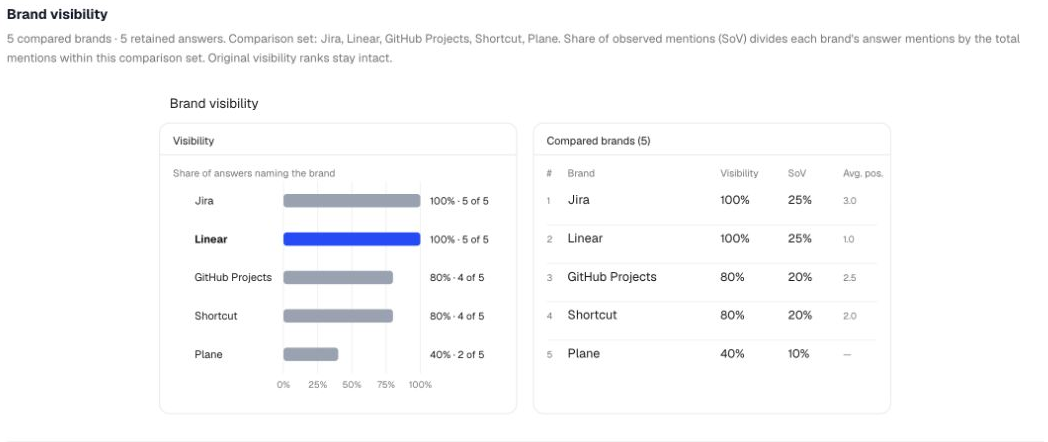
The saved sample contains five usable answers collected on 17 October 2026. Linear is named in all five and its own website is cited in one. The comparison view also shows Jira in five answers, GitHub Projects and Shortcut in four each, and Plane in two.
These observations give the team a useful research direction. Open the retained answers and inspect the discussion of the buyer's requirements. Which trade-offs are described? Which pages are cited? How does the relevant first-party content explain the same workflow or product condition?
Keep the buying question close to the review. A page that answers a generic feature query may serve a different need from a page that helps a fifteen-person team understand its setup responsibilities and ongoing working routine.
Review existing pages before choosing the format
Map each important requirement to the relevant product, integration or documentation page. Record the passage that already explains it, the supporting product fact and the review date. This helps the team see whether useful material needs an update, a clearer connection or a more complete explanation.
The result may be a focused edit to an existing page. It may also justify a new page where the review identifies a meaningful gap. Choose the format after inspecting the evidence and existing content, so the brief explains why that work deserves time.
Build an outline that answers the decision
For this buyer context, an illustrative outline could include a two-week planning workflow, a clear account of how issue updates connect with GitHub and Slack, setup responsibilities and relevant plan or usage conditions. Those sections come from the buyer's requirements.
Each section should answer a practical question. What does the workflow involve? What must the team configure? Who maintains it? Which product conditions should the buyer understand? Product marketing should verify the answers against approved facts and current documentation.
The outline is a proposed editorial approach. It is not a finding that Linear's current pages lack these sections, nor a claim that a particular edit has been made. A page review determines which changes are justified.
Make the brief specific enough to review
The brief should name the target page, intended buyer, required explanations, supporting sources, owner and acceptance check. Attach the original question and the answer evidence that led to the review. This lets a writer see the purpose of the work and a reviewer assess the finished content against the same criteria.
For example, an acceptance check could require an accurate workflow explanation, a documented answer to each relevant setup question and links to the supporting product information. Keep the exact approved statements and review dates with the brief.
IndexHalo's retained Linear example includes proposed work to compare first-party evidence with cited alternatives and to review the ease-of-adoption concern. These proposals provide a starting investigation; the content review should establish the specific page decision.
Carry the completed work into the next review
When approved work becomes public, record its URL, publication date and a concise description of the change. Keep that record with the original question and the supporting answers. It gives the next review a clear account of what the team did and why.
A comparable repeat should keep the question, market, language and source scope consistent. Inspect the actual answer wording and citations as well as the counts. Use the new observation to decide whether to refine the page, continue an investigation or prioritise another question.
Start a free IndexHalo report with a detailed buyer question from your SaaS market. Once the process helps you choose useful work, select the monthly search allowance for your core question set and repeat checks. Every subscription includes the full feature set.
Public Linear example · one buyer question · five usable answers collected 17 October 2026. The current public report was inspected and captured on 20 October 2026; its figures and exact buyer question match the retained evidence. Proposed outlines and acceptance checks are editorial recommendations.
Start your free report, then plan a monthly search routine that fits your team. Every tier includes the full feature set; monthly credits reset without rollover.
